Deciding to explore IVF is rarely a simple moment. It usually comes after months — sometimes years — of trying, testing, and searching for answers. If you are here, you likely already know something is making conception difficult, and you want to understand what IVF treatment actually involves before you walk into a clinic.
This guide explains the IVF process step by step in plain language — no jargon, no false promises. Just a clear picture of what happens at each stage, what it costs, and what the numbers honestly say about success.
What Is IVF?
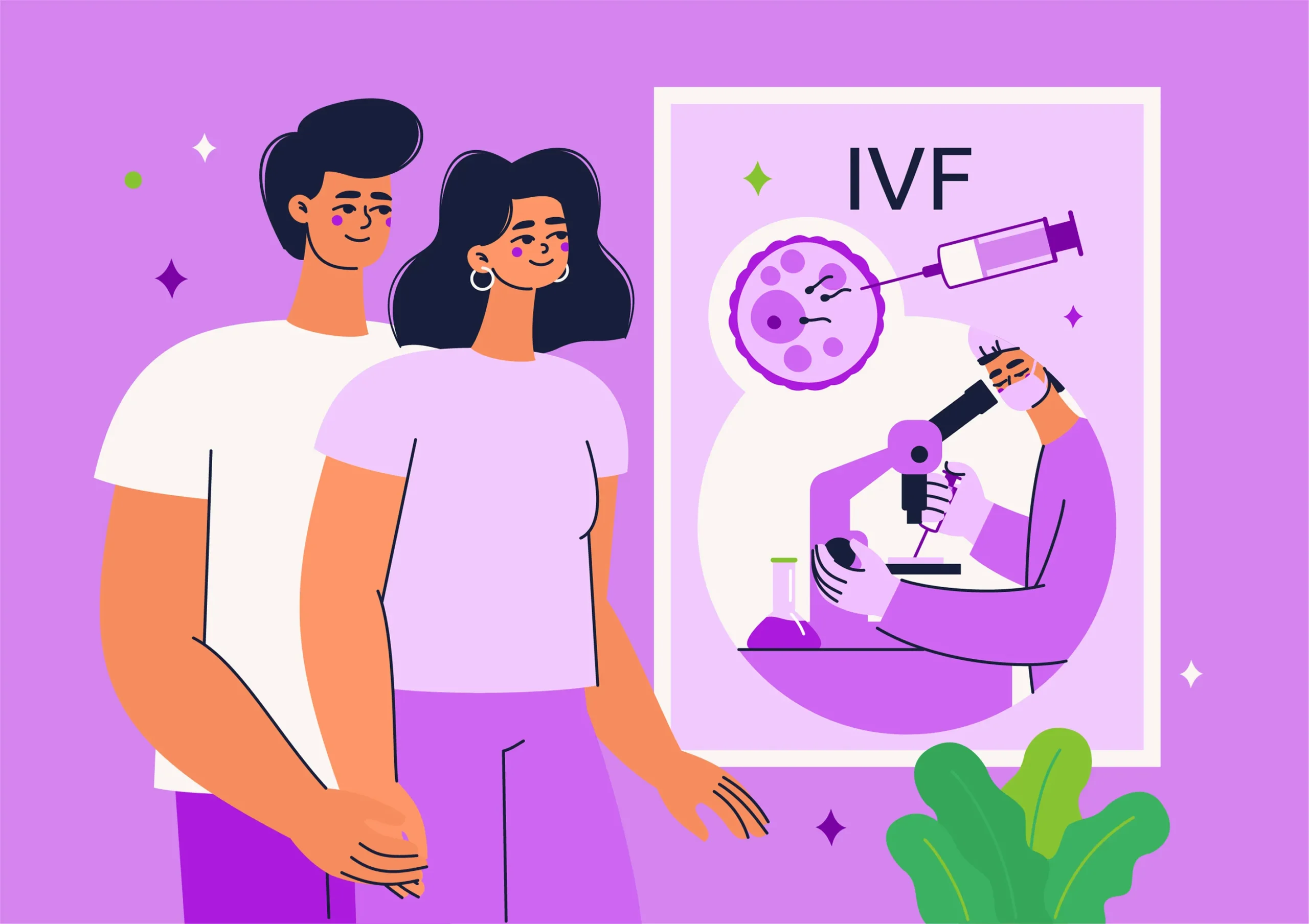
In vitro fertilization (IVF) is a fertility treatment in which eggs are retrieved from the ovaries, fertilised with sperm in a laboratory, and the resulting embryo is transferred into the uterus. The phrase “in vitro” is Latin for “in glass” — a reference to the lab environment where fertilisation takes place outside the body.
A typical IVF cycle takes 4 to 6 weeks from the first injection to the pregnancy test.
Who Needs IVF?
IVF is recommended when simpler treatments like timed intercourse or IUI (intrauterine insemination) have not worked, or when the clinical picture makes them unlikely to succeed. Common reasons include:
- Blocked or damaged fallopian tubes — eggs cannot travel to the uterus naturally
- Male factor infertility — low sperm count, poor motility, or abnormal morphology
- Endometriosis — which can affect egg quality and tubal function
- Unexplained infertility — where no single cause has been identified after investigation
- PCOS/PMOS — particularly when ovulation induction has not resulted in pregnancy
- Age-related decline in ovarian reserve — where time is a factor
- Genetic conditions — where preimplantation genetic testing (PGT) is needed before transfer
IVF is not always the first step — a thorough fertility evaluation determines whether simpler options are worth trying first. Explore fertility consultation services at Dr. Shernaz’s clinic to understand your specific situation.
The IVF Process Step by Step
Step 1: Initial Consultation & Fertility Assessment
Before any treatment begins, both partners undergo a comprehensive baseline assessment:
- For women: AMH (anti-Müllerian hormone) levels, antral follicle count (AFC) via transvaginal ultrasound, day 2/3 hormonal panel (FSH, LH, estradiol), thyroid function, and uterine assessment
- For men: Semen analysis — sperm count, motility, morphology
- Additional tests: Infectious disease screening, genetic screening if indicated
This phase determines the most appropriate IVF protocol for your specific situation and gives the treating doctor a clear starting baseline. Skipping or rushing this stage is one of the most common reasons for suboptimal outcomes.
Step 2: Ovarian Stimulation (Days 1–12 of Cycle)
This is where the active treatment phase begins. You receive daily hormone injections — typically gonadotropins (FSH and LH) — to stimulate the ovaries to develop multiple follicles simultaneously. Under natural conditions, one egg matures per cycle. The goal of ovarian stimulation is to produce 8–15 mature eggs in a single cycle, improving the chances that at least one viable embryo results.
During this 10–14 day phase, you will visit the clinic every 2–3 days for:
- Transvaginal ultrasound to monitor follicle size and count
- Blood tests to check estradiol levels and adjust medication dose if needed
When the leading follicles reach the target size (typically 18–20mm), a trigger injection (hCG or GnRH agonist) is administered to complete egg maturation.
Step 3: Egg Retrieval (Ovum Pick-Up)
Approximately 36 hours after the trigger shot, eggs are retrieved through a minor surgical procedure called ovum pick-up (OPU) or egg retrieval. Performed under sedation (you will not feel pain), a thin needle is guided transvaginally under ultrasound to aspirate the fluid from each follicle. The procedure typically takes 20–30 minutes. You go home the same day with mild rest advised.
The retrieved eggs are immediately handed to the embryologist in the IVF laboratory.
Step 4: Fertilisation & Embryo Culture (Days 1–5 Post-Retrieval)
In the lab, mature eggs are fertilised in one of two ways:
- Conventional IVF — eggs and sperm are placed together in a culture dish and fertilisation occurs naturally
- ICSI (Intracytoplasmic Sperm Injection) — a single sperm is injected directly into each egg; used when sperm parameters are poor or previous fertilisation failure has occurred. IVF with ICSI is now standard practice in most Indian clinics.
Fertilised eggs (now embryos) are cultured in incubators for 3–5 days. By day 5, the best-quality embryos reach the blastocyst stage — the most developed, viable form for transfer.
The embryologist grades embryos based on morphology. Not all retrieved eggs become fertilised, and not all fertilised eggs become blastocysts — this natural attrition is expected and normal.
Step 5: Embryo Transfer
The embryo transfer is a relatively simple, pain-free procedure — no sedation is required. A thin catheter is passed through the cervix into the uterus, and one (or sometimes two) embryos are placed at the optimal position in the uterine cavity. The process takes under 10 minutes.
Fresh transfer — done in the same cycle, 3–5 days after egg retrieval. Frozen embryo transfer (FET) — embryos are cryopreserved and transferred in a subsequent, hormonally prepared cycle. FET is increasingly preferred as it allows the uterine lining to recover from stimulation, often improving implantation rates.
You will be prescribed progesterone support (pessaries or injections) following transfer to support implantation.
Step 6: The Two-Week Wait & Pregnancy Test
Fourteen days after embryo transfer, a blood test measuring beta-hCG levels confirms whether implantation has occurred. This period — often called the “two-week wait” — is emotionally one of the most challenging parts of the IVF journey. Support from your partner, family, or a counsellor during this phase is genuinely valuable.
A positive beta-hCG is followed by serial tests and an early viability ultrasound at approximately 6–7 weeks.
IVF Cost in India: What to Budget
IVF cost in India varies based on the city, clinic, protocol, and whether add-ons (ICSI, PGT, embryo freezing) are required.
|
Component |
Approximate Cost (INR) |
| Initial consultation & investigations |
₹15,000 – ₹25,000 |
|
Ovarian stimulation medications |
₹30,000 – ₹80,000 |
| Egg retrieval procedure |
₹20,000 – ₹40,000 |
|
Lab fees (fertilisation + embryo culture) |
₹30,000 – ₹60,000 |
|
Embryo transfer |
₹15,000 – ₹30,000 |
| Basic IVF cycle total (Mumbai metro) |
₹1,50,000 – ₹2,50,000 |
|
With ICSI add-on |
+₹15,000 – ₹30,000 |
|
With embryo freezing (vitrification) |
+₹15,000 – ₹25,000 |
| Frozen embryo transfer (FET) cycle |
₹50,000 – ₹90,000 |
|
Full cycle with add-ons |
₹2,50,000 – ₹4,50,000 |
Most fertility specialists recommend planning for 2–3 cycles, as cumulative success rates rise significantly with multiple attempts.
IVF Success Rate in India: Honest Numbers
The IVF success rate in India (measured as live birth rate per cycle) varies considerably by age:
|
Age at IVF |
Live Birth Rate Per Cycle |
| Under 35 |
40–55% |
|
35–37 |
30–40% |
| 38–40 |
20–30% |
|
40–42 |
10–20% |
| Over 42 |
Under 10% (own eggs) |
With donor eggs, success rates improve significantly regardless of the recipient’s age, often reaching 60–70%.
Across 2–3 cycles, cumulative success rates for women under 35 can reach 70–80%. Clinic quality, embryology lab standards, and the experience of the reproductive specialist are all significant variables.
What Makes a Good IVF Outcome?
Beyond age, the factors most predictive of IVF success include:
- Ovarian reserve (AMH and AFC)
- Embryo quality — grading and blastocyst development
- Uterine receptivity — thickness and pattern of the endometrial lining
- Sperm quality — especially DNA fragmentation levels
- Lifestyle factors — weight, smoking, alcohol, and stress all demonstrably affect outcomes
An honest pre-cycle conversation with your doctor about these factors gives you a realistic expectation — which matters as much as any clinical parameter.
Starting Your IVF Journey in Mumbai
IVF treatment in India is among the most affordable in the world — 60–70% less than equivalent treatment in the US or UK — with leading clinics in Mumbai offering internationally comparable lab standards and outcomes.
If you are considering IVF for the first time — or have had a failed cycle elsewhere and want a second opinion — Dr. Shernaz Damkevala (Dastur) provides fertility consultation and gynaecological care at Ahura Nursing Home, Malad West, Mumbai, including guidance on whether IVF is the right next step for your situation.
For those managing conditions like endometriosis or PCOS/PMOS alongside fertility concerns, an integrated approach often improves IVF outcomes.
FAQs
Q1. How long does one IVF cycle take?
A: A full IVF cycle — from the first injection to the pregnancy test — takes approximately 4 to 6 weeks.
Q2. How much does IVF cost in India in 2026?
A: A basic IVF cycle in Mumbai costs ₹1.5 to ₹2.5 lakhs. With add-ons like ICSI and embryo freezing, the total per cycle can reach ₹3.5 to ₹4.5 lakhs.
Q3. What is the IVF success rate in India?
A: For women under 35, the live birth rate per cycle is 40–55%. Success declines with age. Cumulative rates across 2–3 cycles can reach 70–80% for women under 35.
Q4. Is the egg retrieval procedure painful?
A: No. It is performed under sedation. You may feel mild bloating or cramping afterwards, which typically resolves within 1–2 days.
Q5. What is the difference between IVF and ICSI?
A: In standard IVF, eggs and sperm are placed together in a dish. In ICSI, a single sperm is injected directly into each egg. ICSI is used when sperm quality is poor or when previous IVF fertilisation failed.
Q6. What is a frozen embryo transfer (FET)?
A: FET is when embryos from a previous cycle are thawed and transferred in a separate, hormonally prepared cycle. It is often preferred over a fresh transfer as it allows the uterine lining to recover after stimulation.
Q7. How many eggs are needed for a successful IVF cycle?
A: Retrieving 8–15 mature eggs per cycle is the typical goal. Not all eggs fertilise and not all fertilised eggs develop to blastocysts, so more eggs at retrieval generally improve overall chances.
Q8. Can I do IVF if I have PCOS or endometriosis?
A: Yes. Both conditions are common reasons for IVF referral. The stimulation protocol may need to be adjusted (particularly for PCOS to reduce the risk of hyperstimulation), but IVF can be highly effective for both.
Q9. What is the age limit for IVF in India?
A: Under the ART (Regulation) Act 2021, the upper age limit for IVF using own eggs is 50 years for women. However, clinically, outcomes with own eggs decline significantly after 40.
CITATIONS & REFERENCES
- FertilityNetwork India — IVF in India: Process, Cost, Success Rate (updated April 2026) — https://www.fertilitynetwork.in/treatments/ivf
- HomeIVF — IVF in India: Process, Cost, Success Rate (updated June 2026) — https://homeivf.com/treatments/ivf
- Cloudnine Fertility — IVF Treatment in India: How Much Does It Cost? (updated 2026) — https://www.cloudninefertility.com/blog/ivf-treatment-in-india-how-much-does-it-cost
- RISAA IVF — IVF Cost in India 2026 — https://drritabakshi.in/ivf-cost-in-india/
- Srishti Fertility — IVF Success Rate by Age in India 2026 — https://srishtifertility.com/ivf-success-rate-by-age-group-in-2025/
- Government of India — The Assisted Reproductive Technology (Regulation) Act, 2021 — https://prsindia.org/billtrack/the-assisted-reproductive-technology-regulation-act-2021
- World Fertility Services — IVF Cost in India 2026 — https://worldfertilityservices.com/blog/ivf-cost-in-india-with-high-success-clinics/